


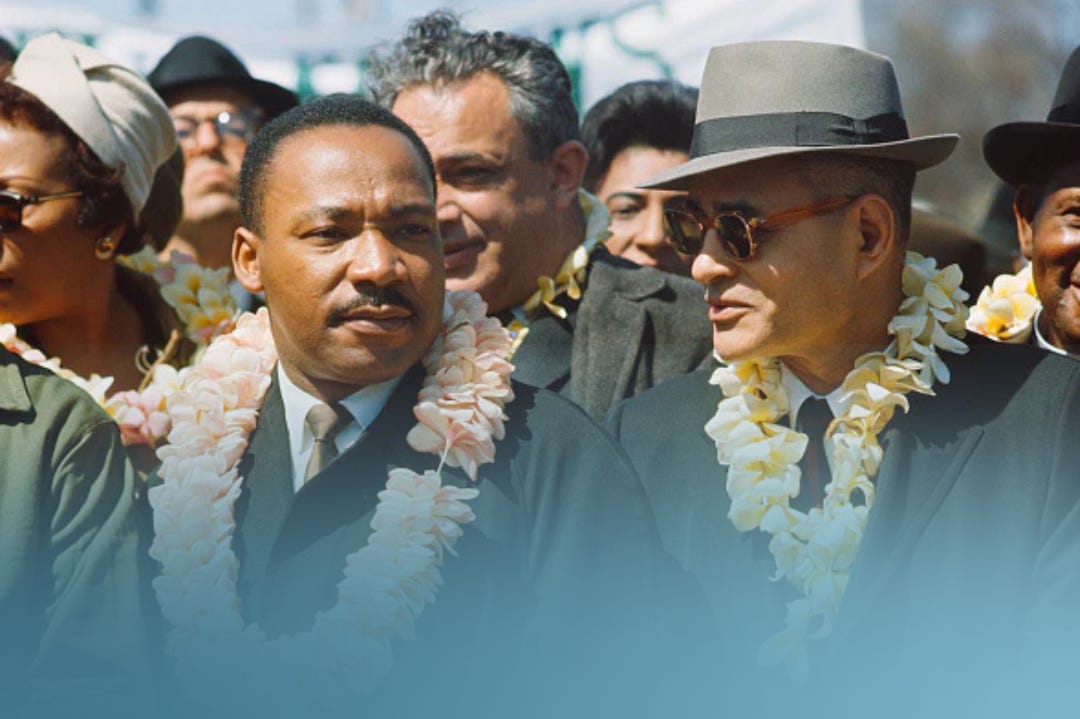
Photo by Steve Schapiro/Corbis via Getty Images, showing Martin Luther King Jr. and fellow civil rights leaders wearing leis as symbols of peace and solidarity during the Selma to Montgomery march.
Today we remember and celebrate the prophetic leadership of Rev. Dr. Martin Luther King Jr. in America’s long struggle for racial justice. Dr. King’s vision was radically inclusive. He sought shalom for all of God’s beloved community. His opposition to the Vietnam War—often overlooked—reveals the depth of his moral imagination and his insistence that racism, militarism, and materialism are deeply intertwined threats to God’s kingdom.
Because much of the Asian American population arrived in the United States after the 1965 Hart-Celler Immigration and Nationality Act, our communities can too easily inherit the fruits of the Civil Rights Movement without fully reckoning with its costs. Yet without the courage, sacrifice, and sustained leadership of Black activists and organizers, Asian Americans would not enjoy the freedoms and opportunities we do today. We, along with all Americans, owe an enduring debt of gratitude to those whose labor—and lives—reshaped this nation.
During the Civil Rights Movement, Asian Americans comprised only about half of one percent of the U.S. population. Our presence was limited, but not absent—members of the Japanese American Citizens League, including Todd Endo, marched in Selma. Vincent Wu, a Chinese American volunteer marshal, walked alongside Dr. King as part of his security team. And Pastor Abraham Akaka of Hawaiʻi, a friend of Dr. King, sent a contingent bearing leis—symbols of truth-telling—to clothe the marchers.
Honoring Dr. King today calls us not only to remember, but to recommit ourselves to justice, solidarity, and the unfinished work of beloved community.

Dr. Daniel D. Lee is Academic Dean for the Asian American Center at Fuller Seminary and Associate Professor of Theology and Asian American Studies. His scholarship and teaching focus is on theology, culture, and the lived experiences of Asian American Christian communities.
The Asian American Center equips, enriches, and emboldens Asian American Christians through the Pastoral Formation Initiative, the Asian American Well-Being Collaboratory, the Asian American Christian History Institute, the Filipino American Ministry Initiative (FAMI), and the Korean American Ministry Initiative (KAMI), —grounding scholarship, formation, and ministry in lived experience.