


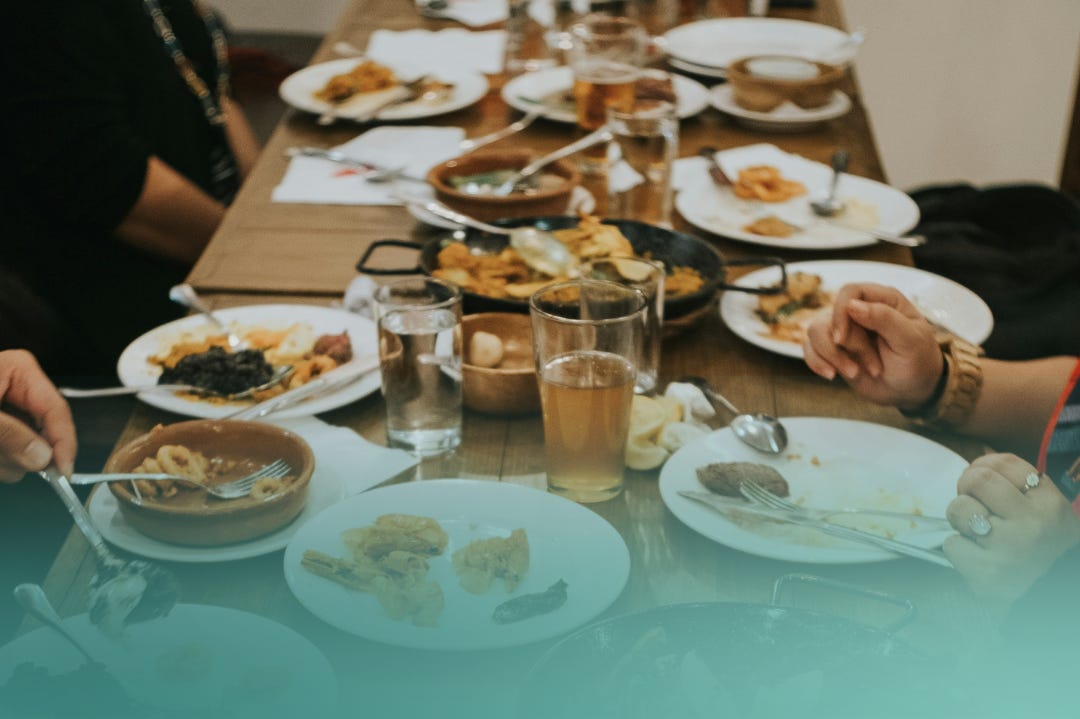
As a Filipina American, the oldest daughter of immigrants, who studied psychology and religious studies, and completed a Master of Arts in Theological Studies, my most formative theological education was not in the classroom but at the dinner table.
The Table as Sanctuary
My parents immigrated to the United States with pure grit. They faced the daunting demands of establishing a career and home for their young family while resisting the temptation of total assimilation. They committed to eight-hour days with twelve-hour hearts. They carried an exhaustion that settled into their bones and the weight of building a life in a country that had long primed them to arrive—and then quietly reminded them they did not belong.
And still, despite the exhaustion, every night, we gathered. Dinner, no matter how late, was our place, our nourishment and connection. And more importantly, it was our place to bring our experience of the world to the table and to join one another in making meaning of the strife, suffering, challenge, and hope in front of us.
Dinnertime Exegesis
My parents told stories the way a preacher wrestles with a text: carefully, with attention to what is beneath the surface. They narrated the complexities of their white colleagues—how they moved, what they assumed, what it cost to keep up. They spoke not with bitterness but with the precision of people reading the room for survival. These were not simply family updates. They were a form of exegesis.
The God Who Traveled With Us
And always, the stories returned to God. The God who preserved my grandparents as children during World War II. The God who provided physically and financially for ailing Titas and Titos. The God whose faithfulness appeared in the form of sponsored work visas, then later, green cards, and eventually, a home and a zip code that granted us educational access. The God who had not forgotten us but had been with us intimately through the journey.
This, they communicated to us, is the God who has held us in the grief of leaving home and the grace of arriving somewhere.
This is the God of Abraham, Isaac, and Jacob, “compassionate and gracious…slow to anger, abounding in love and faithfulness:” a God who moves through migration, displacement, and wills for shalom.
Storytelling As Resistance
My parents were my first theological teachers. In their own real, raw, and imperfect way, they taught me how to offer my lived experiences in the world to find God at the table.
My Filipino American family has long practiced the ancient tradition of storytelling—wrestling and remembrance. It is the act of locating one’s life within the larger story of God’s active presence and liberating movement in the world.
In a culture shaped by colonial forces that teach us to measure ourselves by white normativity, storytelling is our act of resistance. Just as the early church practiced against Roman occupation, we can practice storytelling to witness God’s advocacy for our collective dignity. To name God is to welcome his compassionate faithfulness and insist on his presence among us.
May the God of Abraham, Isaac, Jacob, Maria Raquel, and Joel enliven our stories as we continually come to the table and seek him.

Francesca De Las Alas, MTS is a 1.5-generation Filipino American based in the Bay Area, where she lives alongside her sister and parents, Maria Raquel and Joel. She is a Program Manager for breast cancer care and serves as a Catechist at her local parish. As a bi-vocational leader, she works at the intersection of healthcare and formation, carving spaces of belonging in a changing world. Francesca is a graduate of Fuller Seminary.
About Centering
Centering: The Asian American Christian Substack is a publication of the Asian American Center at Fuller Seminary (AAC). At the AAC, we train and support Asian American Christian leaders of East, Southeast, and South Asian descent, including multiracial individuals and adoptees – grounding their life and work in over 170 years of Asian American history, and addressing their spiritual and psychological concerns.
We do this work through our cohorts, seminary courses, and the programs of our initiatives. The AAC is home to the Asian American Pastoral Formation Initiative, the Asian American Well-Being Collaboratory, the Asian American Christian History Institute, the Filipino American Ministry Initiative, and the Korean American Ministry Initiative.
To learn more and support our work, visit aac.fuller.edu.
For information about Fuller Seminary’s degree programs and continuing education resources, visit fuller.edu.